
 中文简体
中文简体 русский
 Français
 Español
 Português
 Deutsch
 عربى
عربى italiano
 Türk
Türk

Search
Categories
Recommend News
Categories
Recommend News
-
Industry News
-
Industry News
-
Industry News
-
Industry News
Oct 05, 2026 - By admin
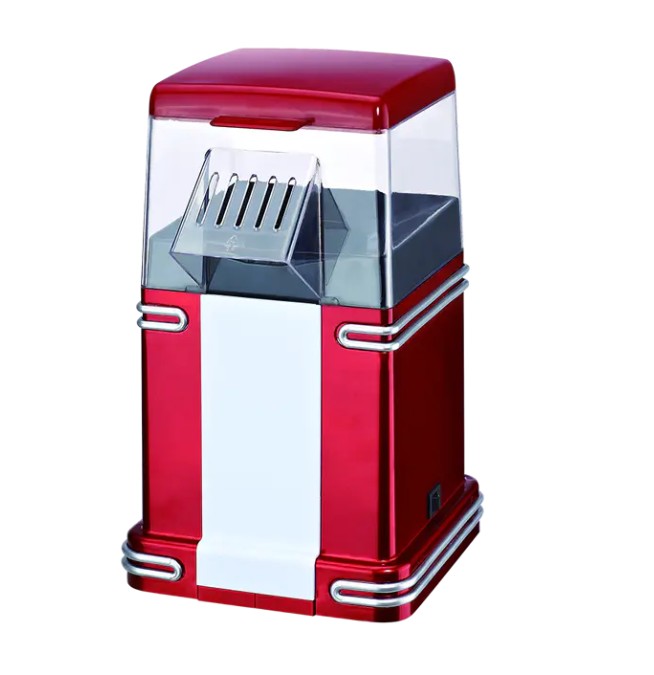
Hot Air Popcorn Maker Sourcing Guide for Wholesale, OEM and Private Label
Two hot air popcorn makers can arrive in identical cartons, carry the same power rating, and still behave nothing alike on a countertop. One clears a full chamber in about two and a half minutes and leaves a small handful of unpopped kernels behind. The other scorches the top layer, dumps a third of the corn back into the bowl unpopped, and quietly turns into a return. The difference almost never appears on a specification sheet you receive in a quotation. It hides in the airflow path, the chamber geometry, the thermostat tolerance, and how carefully the factory controls the gap between those three.
That is the short version. If you buy a hot air popcorn maker for a retail chain, a housewares brand, a party supply distributor, or a foodservice operator, treat it as a small thermal and aerodynamic machine rather than a generic small appliance. Buyers who understand the machine get fewer complaints, fewer returns, and far more leverage at the negotiating table. The rest of this guide walks through what actually matters, in the order it tends to matter during a real sourcing project.
What a Hot Air Popcorn Maker Actually Is, and Why It Wins Volume Orders
A hot air popcorn maker uses a stream of heated air to both pop the kernels and keep them moving. There is no oil in the popping chamber, no stirring paddle in most designs, and no microwave-safe silicone bowl to lose in a drawer. The heating element warms the airflow, a fan pushes that air up through a perforated chamber floor, and the corn circulates in the current until the internal moisture turns to steam and the kernel bursts. The popped corn rides the same air current up a chute and lands in a bowl or a collection tray.
From a manufacturing standpoint, that simplicity is the whole commercial argument. A hot air popcorn maker typically has fewer moving parts than an oil-based theater popper, which means a shorter assembly line, a lower bill of materials, and fewer warranty claims tied to a stirring mechanism that can jam. It also means less cleaning for the end user, and that single fact drives a large share of repeat purchases and positive reviews.
The trade-offs are real and worth stating plainly before you write a purchase order:
- Flavor profile. Air-popped corn tastes lighter and drier than oil-popped corn. Buyers who expect a cinema-style buttery result may be disappointed if the packaging does not set the right expectation.
- Kernel sensitivity. Air poppers are more sensitive to kernel size and moisture content than oil poppers. A batch of very dry kernels can pop too fast and scorch; a batch of overly moist kernels leaves more unpopped weight behind.
- Noise and airflow. The fan noise level becomes a genuine review factor in small apartments and open-plan kitchens.
- Chamber capacity. Compact models often pop between 50 and 70 grams per batch. Larger household and light commercial units can push past 100 grams.
None of these are deal-breakers. They are specification decisions, and they need to be made deliberately rather than inherited from whatever sample happened to arrive first.
The single most useful shift in thinking is this: a hot air popcorn maker is bought on airflow design and thermal consistency, not on wattage. Two units rated at 1200 W can perform completely differently, because wattage describes power draw, not how that heat is delivered to the kernel.
Inside the Machine: The Parts That Decide Whether a Batch Pops Evenly
When a sample underperforms, the cause is almost always traceable to one of five areas. Knowing them makes it much easier to give a supplier precise, testable feedback instead of a vague complaint about "uneven popping."
1. The airflow path and chamber geometry
The chamber floor, the hole pattern, the angle of the chute, and the volume of air the fan can move all work together. If the airflow is too weak, kernels settle in the center, sit against the hot floor, and scorch while the outer ring stays cold. If it is too strong, popping corn gets ejected before it is fully expanded. A well-designed chamber keeps each kernel tumbling continuously, which spreads heat evenly and shortens the average time to pop.
2. The heating element and thermostat tolerance
Popping happens in a fairly narrow thermal window, roughly between 175 and 200 degrees Celsius at the kernel surface. A thermostat with a wide tolerance band, plus or minus ten degrees Celsius for example, produces visible batch-to-batch variation on the same machine. Tighter control costs slightly more per unit and is usually worth every cent, because consistency is what shoppers actually notice over months of use.
3. Food-contact materials and coatings
The chamber, the chute, and the lid all contact food while hot. Material choice affects smell, discoloration, and how easily the unit wipes clean. Buyers selling into markets with strict food-contact rules need documentation for every food-contact component, not just the chamber itself.
4. Motor and bearing durability
The fan motor runs under continuous heat load, which is a harder duty cycle than most small appliance motors face. Bearing quality and thermal shielding around the motor determine whether the unit still sounds the same after two hundred batches or develops a rattle in month three.
5. Lid retention and kernel containment
A lid that lifts under pressure, or a chute that lets unpopped kernels escape into the bowl, generates complaints that read as quality failures even though they are mechanical design issues. Test containment with a full chamber, not a half-filled one.
If you only tighten one specification before mass production, tighten the thermostat tolerance and validate it with a full-chamber test. Thermal consistency affects popping rate, scorching, and unpopped weight all at once.
Hot Air, Oil and Microwave Popping: A Practical Comparison for Buyers
Most sourcing teams compare popping methods at some point, usually because a retail buyer asks why the shelf should carry one format over another. The comparison below focuses on the criteria that actually influence purchasing decisions, return rates, and shelf positioning rather than on personal preference.
| Criteria | Hot air popcorn maker | Oil-based popper | Microwave silicone popper |
|---|---|---|---|
| Oil required | None | Yes, typically 1 to 3 tablespoons | Optional |
| Typical batch time | 2 to 4 minutes | 4 to 6 minutes | 3 to 5 minutes |
| Cleaning effort | Low, wipe chamber and chute | Moderate to high, oil residue | Low, but bowl must be washed |
| Moving parts | Fan only in most designs | Fan plus stirring mechanism | None |
| Electrical safety scope | Full appliance certification required | Full appliance certification required | No electrical parts |
| Retail positioning | Health, speed, easy cleanup | Flavor, cinema experience | Budget, small storage footprint |
| Typical end user | Households, gifting, light commercial | Households, party rental, foodservice | Students, small households |
| Complaint pattern | Noise, unpopped kernels | Cleaning, oil mess | Capacity limits, uneven heat |
The pattern in the table explains why hot air models tend to hold up well in gift channels and health-conscious retail segments, while oil-based units keep a firm grip on venues that sell the cinema experience. A microwave popper is a different product entirely and rarely competes directly with either, since it carries no electrical certification burden and no cord.
For a distributor building a range, the practical conclusion is that a hot air popcorn maker covers the widest set of end users per unit of certification cost. It is one certified appliance that can be sold into households, gifting, office pantries, and light commercial snack service.
One certified hot air unit serves more sales channels than any other popping format, which is why it is usually the first SKU a distributor adds. Lower certification overhead per channel is the real commercial advantage.
Specifications to Lock Before You Place an Order
Before looking at where design effort should go, it helps to understand how buyers and factories usually divide their attention. The list below reflects how these variables are weighed in sourcing discussions and why a small number of them absorb most of the follow-up work.
Relative influence of design areas on final popping results and return rates
Airflow path and chamber geometry
Heating element and thermostat tolerance
Food-contact materials and chamber coating
Motor and bearing durability under heat
Packaging, manual and plug-standard compliance
Illustrative weighting based on typical sourcing priorities, not laboratory measurements.
Read the chart as a map of where engineering attention pays off, not as a precise scoreboard. Airflow and thermal control sit at the top because they shape the user experience from the very first batch, and because correcting them after tooling is expensive. Food-contact materials sit slightly lower in design effort but carry a much higher compliance risk, since a documentation gap can stop a shipment at the port.
Motor durability and packaging compliance come last in design effort but not in consequence. A manufacturer that can supply a hot air popcorn maker with a stable motor and a correctly localized manual and plug standard saves the buyer months of back-and-forth, especially across multi-language markets. That is the kind of detail a manufacturer with an established NPI process handles routinely, because it maintains test equipment, standard operating procedures, and a multi-language documentation workflow rather than rebuilding them for each order.
Design effort is front-loaded, but consequences are evenly spread. A compliance or documentation gap costs far more to fix after shipment than airflow tuning costs before tooling.
OEM and ODM: What Customization Really Involves
Buyers new to small appliance sourcing often assume customization means choosing a color. In practice, an experienced manufacturer will break customization into layers, and each layer changes cost, tooling, and lead time.
Cosmetic customization
Housing color, finish, printed logo, and packaging artwork sit at the lowest layer. These changes rarely require new tooling and are usually the fastest to implement. They are also the least defensible commercially, because any competitor can order the same change.
Electrical and regional customization
Voltage and frequency, plug type, cord length, and label language all vary by market. A unit built for 120 V at 60 Hz cannot simply be relabeled for a 230 V market. Buyers selling into Europe, the Middle East, or Latin America need the electrical configuration and the certification pathway confirmed at the quotation stage, not after sampling.
Structural and functional customization
This is where a real OEM relationship begins. Chamber capacity, chute design, lid retention, switch placement, and the addition of a butter-melting tray or a measuring cup all require design work and, in many cases, new injection molds. Factories that hold product patents and run a structured new product introduction process can move from concept to a validated sample in a defined sequence. Factories that do not will improvise, and the schedule slips.
Documentation and packaging customization
Instruction manuals, safety warnings, warranty cards, and retail packaging are frequently the last items ordered and the first items to delay a shipment. For multi-language programs, confirming which languages are required before the artwork is frozen saves a costly reprint.
- Ask for a written list of what is standard and what is considered custom.
- Confirm which changes affect tooling cost and which do not.
- Confirm which changes affect certification and which do not.
- Confirm the sample approval stage that locks the specification.
Cosmetic changes are cheap and easy to copy; electrical and structural changes are what actually differentiate a private-label hot air popcorn maker. Spend the customization budget on airflow, thermal control and regional compliance, not on color.
Testing, Certifications and the Questions That Separate Vendors
Every market has its own compliance pathway, but the underlying tests are broadly similar. A competent supplier will already have a test regime in place and will be able to describe it without hesitation. A supplier that answers vaguely is telling you something important.
Tests worth asking about specifically
- Temperature rise and abnormal operation. What happens if the chamber is overfilled, or if the unit runs empty for ten minutes?
- Leakage current and insulation resistance. Standard electrical safety checks that must hold after heat cycling, not only on a cold unit.
- Thermal cut-off and fuse verification. Confirm that the safety device actually interrupts power under fault conditions.
- Endurance running. A repeated batch test that reveals motor degradation and coating discoloration over time.
- Drop and packaging transit tests. Retail shipping damage is a cost centre that buyers underestimate.
- Food-contact material documentation. Traceability for every component that touches hot corn.
Certification questions
Ask which certification marks the factory already holds for comparable products, which marks the specific hot air popcorn maker configuration will carry, and whether the certificate lists the exact model and voltage variant you are ordering. A certificate covering a different model number is not much use at customs.
A factory with advanced manufacturing and testing equipment, standardized operating procedures, and documented product testing steps can normally answer all of the above with records rather than reassurances. When a supplier describes continuous process optimization aimed at improving yield, that is a signal that quality control is treated as an ongoing practice rather than a one-time inspection.
Ask for the certificate that names your exact model and voltage variant. A general factory certificate does not protect your shipment at customs.
Capacity, MOQ and Delivery: What a Manufacturer Can Realistically Promise
Once the specification is agreed, the conversation moves to volume and timing. This is where buyers most often miscalculate, usually by assuming that a large factory means a small order is easy.
Size matters in a specific way. A manufacturer operating a 20,000 square metre facility with around 300 employees and a stated daily capacity of up to 10,000 units across its product range is structured to serve buyers of different scales. That flexibility is genuinely useful for distributors who want to start with a modest trial order and scale up once a retail listing is confirmed. But capacity is shared across a product portfolio that typically includes air fryers, popcorn makers, cotton candy machines, and drink preparation equipment, so the practical question is not total capacity but the scheduled allocation for your specific line.
Questions to ask about volume and timing
- What is the minimum order quantity for a standard configuration, and how does it change with a custom housing color?
- What is the minimum order quantity when a new mold is required?
- How many units per production day are allocated to this product line?
- What is the sample lead time versus the mass production lead time?
- Which components have long procurement lead times, and how are they stocked?
- What is the policy if a shipment fails incoming inspection?
On timing, treat the sample stage as the real schedule driver. Mass production for a hot air popcorn maker with an approved specification and existing tooling generally runs considerably faster than a first order that requires mold modification. Buyers who build a buffer around the sample approval step, rather than around the shipping step, tend to hit their retail windows.
Sample approval, not production, is usually the schedule bottleneck. Budget the buffer around tooling and sampling, and the shipping date takes care of itself.
Four Buying Scenarios, Four Different Specifications
The same product name covers very different requirements depending on who will use it. Matching the specification to the scenario prevents the most expensive kind of mismatch, which is buying too much machine for the channel.
Household retail
Compact chambers, quiet operation, easy wipe-clean surfaces, and a footprint that fits a standard cabinet. Noise and cleaning are the two factors most likely to appear in reviews, so they deserve more engineering attention than a marginally larger chamber.
Party and entertainment use
Here the requirements shift toward throughput and continuous operation. A unit expected to run batch after batch during an event needs stronger motor cooling and a chamber that does not need to cool down completely between loads.
Retail gifting and seasonal programs
Packaging becomes as important as the appliance. Print quality, box strength for stacked pallet shipping, and a manual that is correct in every required language determine whether a seasonal program launches on schedule.
Light commercial and foodservice support
Units used behind a counter need a documented duty cycle, a cord length that reaches the outlet, and a service plan for replacement parts. Buyers in this segment should ask specifically about spare part availability and the expected service life expressed in batches rather than years.
Across all four scenarios, the recurring theme is that a supplier experienced in serving both household and commercial customers can advise on which specification is realistic for the channel rather than simply quoting the cheapest configuration that matches the brief.
Matching specification to scenario prevents the most common and most costly sourcing error. Buying a commercial-duty unit for a household channel wastes margin; buying a household unit for commercial use creates returns.
Common Sourcing Mistakes and How to Avoid Them
Most problems in this category repeat themselves across buyers and markets. Each one has a straightforward countermeasure.
- Comparing wattage instead of airflow. Wattage tells you how much power the unit draws, not how effectively the heat reaches the kernel. Ask for a full-chamber popping test with the unpopped weight recorded.
- Approving a sample filled halfway. Half loads hide scorching and containment problems. Always test at maximum stated capacity.
- Leaving the manual until last. Instruction content affects certification and packaging artwork. Freeze it early.
- Assuming one certificate covers all variants. Voltage variants and plug types often need separate listings.
- Ignoring transit packaging. A unit that survives a drop test in a thin carton is rarer than most buyers expect.
- Skipping the spare parts conversation. Distributors carrying inventory need access to replacement lids, trays, and cords.
- Treating the first order as the only order. Specification changes made after the first shipment are far more expensive than changes made before tooling.
Each of these mistakes is cheap to prevent and expensive to correct. The pattern behind all of them is the same: treating a small appliance as a commodity purchase rather than as a manufactured product with a defined performance envelope.
Test at maximum capacity, freeze documentation early, and confirm certification per variant. These three habits eliminate most of the delays that buyers blame on suppliers.
About the Manufacturer Behind This Guide
The perspective in this article comes from a working small appliance manufacturer rather than from a retail review desk. Cixi Homease Electrical Products Co., Ltd, operating at homease.com.cn, describes itself as a professional small appliance manufacturer engaged in research, design, and manufacturing, with an integrated development, production, and sales operation.
Cixi Homease Electrical Products Co., Ltd
Product range: popcorn makers including hot air popcorn makers, retro popcorn makers and tabletop popcorn poppers, plus cotton candy machines, air fryers, chocolate fountains, ice makers, slush machines and milkshake makers.
Manufacturing footprint: a 20,000 square metre facility, approximately 300 employees, and a stated daily capacity of up to 10,000 units across the product range.
Capabilities: custom design, multiple product patents, new product introduction support through to volume production, a comprehensive production management system, standardized operating procedures, and multi-language documentation across markets including English, Chinese, Russian, French, Spanish, Portuguese, German, Arabic, Italian and Turkish.
Typical applications: home kitchens, party and entertainment settings, retail channels, and foodservice applications.
Buyers evaluating a hot air popcorn maker program can use the capabilities above as a checklist. Ask any candidate supplier whether they can match each item, and compare the answers against the specification questions raised earlier in this guide.
Frequently Asked Questions
What exactly makes a hot air popcorn maker different from a regular popcorn popper?
A hot air popcorn maker pops corn using a heated air stream and requires no oil, while oil-based poppers heat a small amount of oil in a chamber and usually stir the kernels with a rotating arm. The practical consequences are lighter flavor, easier cleanup, fewer mechanical parts, and a different set of performance variables, chiefly airflow and thermal consistency.
How many grams should a single batch hold?
Compact household models typically pop 50 to 70 grams per batch, while larger household and light commercial units can handle more than 100 grams. The correct figure depends on the channel, not on the maximum the chamber can physically accept.
Why does the same model perform differently between batches?
Two reasons dominate. First, thermostat tolerance creates small temperature swings that change popping behavior. Second, kernel moisture content varies between suppliers and seasons, and air poppers are more sensitive to that than oil poppers. Tightening the thermostat specification solves the first; specifying a kernel grade in the manual or packaging solves the second.
What should a buyer ask a hot air popcorn maker manufacturer before ordering?
Ask for a full-chamber popping test with unpopped weight recorded, the thermostat tolerance band, the certification listing for the exact model and voltage variant, the sample and production lead times, the minimum order quantity for both standard and customized configurations, and the availability of spare parts.
Is a hot air popcorn maker suitable for commercial use?
It depends on the duty cycle. Units used continuously behind a counter need stronger motor cooling and a documented service life expressed in batches. Household-rated units used in a commercial setting tend to fail earlier, so buyers in foodservice should confirm the intended duty cycle in writing.
How much does customization affect lead time?
Cosmetic changes such as color and logo rarely add significant time. Structural changes that require new molds add the most, followed by electrical variants that require separate certification. Documentation and packaging changes are fast to implement but easy to delay, which is why they should be finalized early.
What is the most common cause of returns in this product category?
Uneven popping and scorching caused by airflow or thermal issues, followed by noise complaints and mechanical failures such as lid retention. All three are addressable at the design stage with a full-chamber test protocol and a defined thermostat tolerance.
Every recurring return reason in this category traces back to a specification that was never written down. Document the test protocol and the tolerance band before tooling, and the return rate follows.
A hot air popcorn maker looks like a simple product, and in many ways it is. That simplicity is exactly why the details matter so much. With no oil and almost no moving parts, there is nothing to disguise a weak airflow design, a loose thermostat, or a chamber that lets kernels sit against the hot floor. The performance is visible in every batch, which means the specification has to be right before the molds are cut.
For buyers, the working sequence is consistent. Decide the channel and the duty cycle first. Lock the airflow and thermal specifications second. Confirm the certification pathway for each voltage variant third. Then finalize documentation, packaging, and spare part arrangements. A manufacturer that can walk through all four stages with records rather than promises is the one worth building a long-term program with.
Related products
Get in Touch
Your email address will not be published.
Required fields are marked *
Required fields are marked *
contact us
Have a project in mind?
Contact with us
Contact with us
We are happy to answer your questions. Please fill out this form
and one of our professional team will get back to you as soon as possible.
and one of our professional team will get back to you as soon as possible.
-
Company AddressNO.212 Qiaotou Road, Qiaotou Town, Cixi City Zhejiang Province
-
Tel:+86-574-63032602/63032605/63032682/63032681
-
E-mail:homease@homease.com.cn
huajun_sam@homease.com.cn
jayden@homease.com.cn
sunny@homease.com.cn
Copyright © Cixi Homease Electrical Products Co., Ltd. All Rights Reserved. China Small Home Appliances Manufacturer Food Equipment Factory
